
The only recovery technique you need.
Years ago, I had a wild ankle injury from Netball. I say wild because the bruise was gnarly but in the grand scheme of things, it actually wasn’t that bad. I was recommended to do contrasting hydrotherapy. A great idea, but the method recommended to me missed the mark on the finer (and important) details.
5 minutes of a pleasant warm temperature, 5 minutes of icy cold water repeated multiple times. I vividly remember this because I hated it so much I was crying the whole 5 minutes of cold time (I’m a lot tougher now btw). After studying naturopathic hydrotherapy, I’ve learned the proper technique, and I was absolutely missing the mark and probably wouldn’t have been crying out in agony and wouldn’t have the injury linger for a longer time than necessary.
Utilising water is such an under-appreciated tool and so easy to do at home. It is probably my favourite tool and I have loved exploring the effects of them. The body’s healing capabilities are found in the blood; the quantity and the quality of the blood flowing through the body. Naturopathic hydrotherapy is utilising water at different pressures, temperatures and times to manipulate this blood flow to facilitate healing.
Today I am sharing with you the technique for “Alternating Bath” though as always:
Always consult your health care provider prior to implementing anything and take caution to not burn yourself.
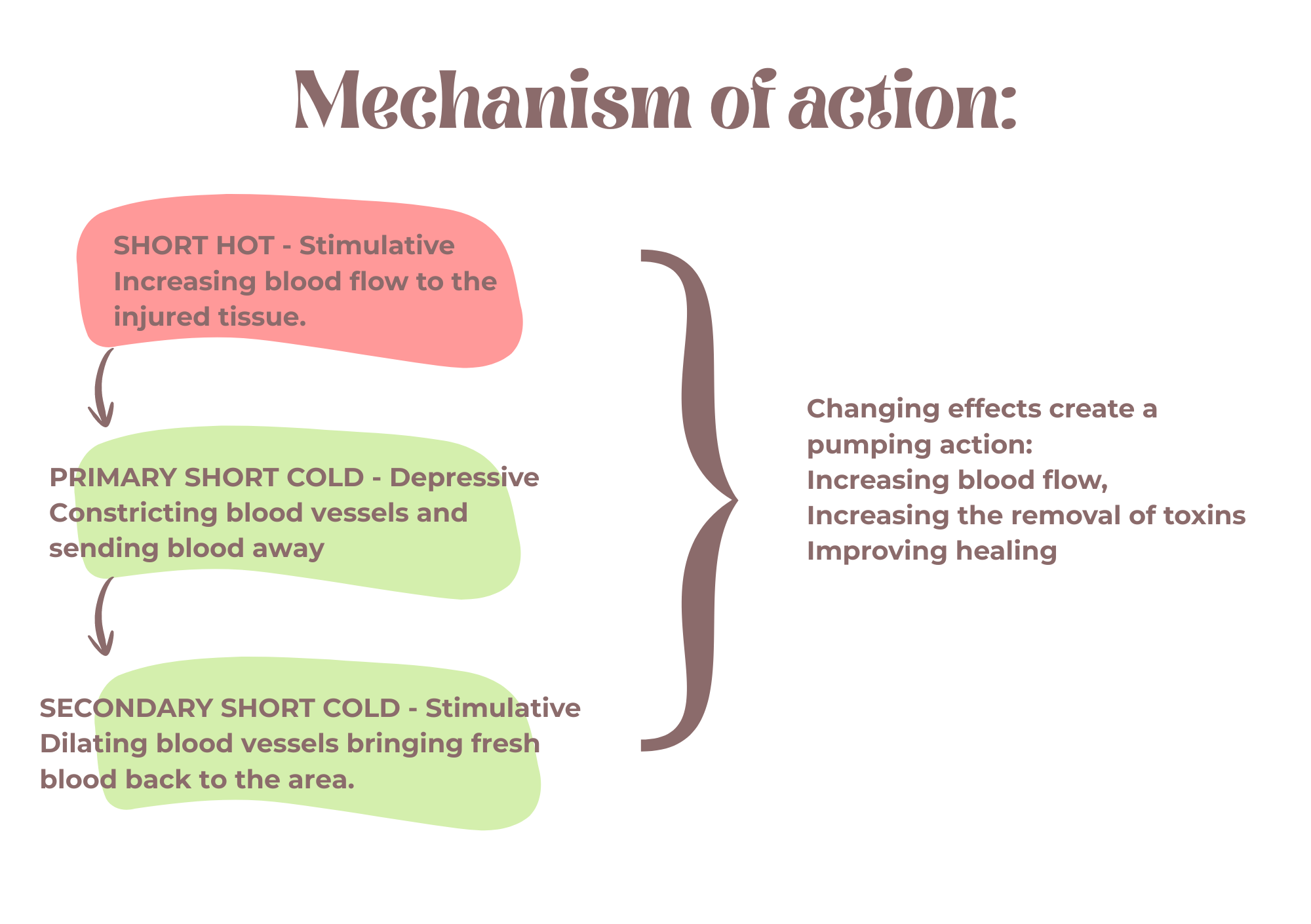
Quick lesson on hydrotherapy: temperatures have different effects on blood flow and metabolism. Let’s look at the effects on blood flow:
COLD:
Primary short cold <20 seconds – depressive
Secondary short cold 30-40 seconds – stimulative peak
Long cold >60 seconds – depressive
HOT
Short hot <5 minutes – stimulative
Long hot >5 minutes – depressive
(Boyle & Saine, 1995)
With that in mind, what would the 5 minutes of cold water be doing? It would have been putting my injured tissue into the long cold exposure which is depressive, decreasing the blood flow to the injured tissue resulting in my ankle screaming at me for some fresh blood. Not to mention the hot water was a comfortable warmth, not nearly hot enough.
Alternating bath (Boyle & Saine, 1995):
What is it? The immersion or soaking of a body part in water alternating between hot and cold multiple times.
Indications:
Sprains (after 24 hours)
Strains (after 24 hours)
Bruises (after 24 hours)
Arthritis
Materials:
- 2 tubs that are large enough to fit the size of the area to be treated.
- Thermometer
- Towels
- Hot water
- Cold water
- Timer
Method - using an example of an ankle injury:
1. Place a towel on the ground, with the tubs on top.
2. Fill the first tub with hot water around 40C. Keep a jug of hot water nearby to up the heat throughout the treatment.
3. Fill the second tub with cold water between 5C and 20C (colder will have a more intense effect)
4. Place the foot in the hot tub ensuring the ankle is covered for 3 minutes.
5. After 3 minutes remove and immediately swap to the cold water for 30 seconds
6. Repeat steps 4&5 for a total of 4-8 times slowly increasing the hot temperature to 43C. Once achieved do not let it cool down and do not exceed this temperature.
7. Once completed dry area and lay down for at least 30 minutes.
NOTES:
The number of sessions to do is variable so consult your health care provider for your individual guide.
Always end on cold
For body parts that won’t easily fit in a tub you can still use the same technique by applying soaking hot and cold towels and covering with woollen blankets.
Let’s break this technique down:
We actually used this technique recently, my husband had been struggling to walk with an extremely tight achilles tendon. After struggling with it for a few days, he gave this a go. Once he was finished resting post treatment the pain was down tremendously, swelling was starting to subside and he wasn’t using our toddler’s scooter as his mobility scooter anymore. After the second treatment he is back to normal.
A moment for the ice pack: I am not saying to be rid of the classic ice pack, though many naturopathic hydrotherapists call it unnecessary and suppressive. They still can have their uses especially when the goal is to lower the inflammation for a bit of pain relief. But inflammation is the body trying to heal, it’s bringing in blood, nutrients and resources. Suppressing that, will slow healing but helping it in and out will help the healing.
Ask your provider and if you give this a go, let me know how you get on!
References:
Boyle, W & Saine, A (1995). Lectures in Naturopathic Hydrotherapy. Eclectic Medical Publications.